
One of the most widely used tools for assessing the accuracy and reliability of classification models is the ROC curve, short for Receiver Operating Characteristic curve. This powerful visual tool helps data scientists understand how well a model is distinguishing between different classes. If you’re eager to deepen your understanding of such key concepts, enrolling in a Data Science Course in Delhi at FITA Academy can provide you with the hands-on training and expert guidance needed to advance your career in this fast-growing field.
Understanding the Basics of the ROC Curve
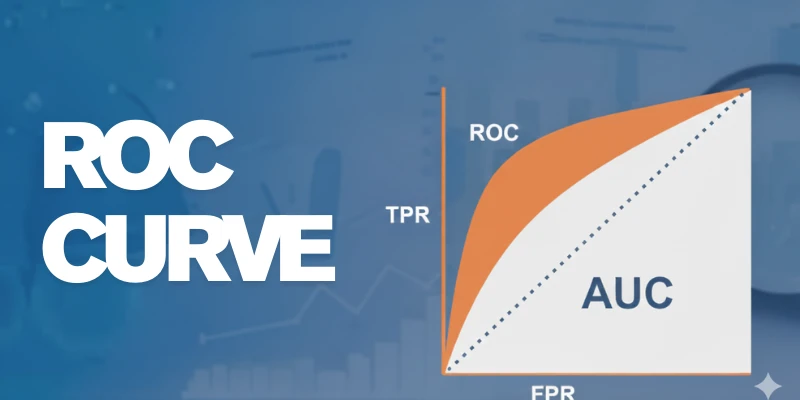
The ROC curve shows a classification model’s performance graphically at various threshold values. The True Positive Rate is displayed on the vertical axis and False Positive Rate is shown on the horizontal axis.
The True Positive Rate, sometimes referred to as sensitivity or recall, quantifies the percentage of real positives that the model accurately detects. Conversely, the False Positive Rate quantifies the percentage of real negatives that were mistakenly labeled as positive. By contrasting these two rates, the ROC curve demonstrates how well the model separates the positive and negative classes.
Why the ROC Curve Matters in Model Evaluation
Not all models perform equally well, and accuracy alone can sometimes be misleading. For example, in cases where one class significantly outnumbers the other, a model might show high accuracy but still perform poorly on the minority class. This is where the ROC curve becomes useful. Enrolling in a Data Science Course in Mumbai will help you learn more about these crucial assessment methods and hone your abilities by providing you with real-world knowledge and experience.
The ROC curve provides a more comprehensive perspective by evaluating both true positives and false positives. It helps in identifying the trade-offs between sensitivity and specificity. In simple terms, it shows what you gain in detecting positive cases and what you lose by misclassifying negatives.
Interpreting the ROC Curve: What the Shape Tells You
The shape of the ROC curve tells you a lot about your model’s performance. When a model is performing flawlessly, a curve that shows a True Positive Rate of 1 and a False Positive Rate of 0 will cross the graph’s upper-left corner. This indicates that every positive and negative instance was accurately detected by the model.
On the other hand, a model that does no better than random guessing will produce a diagonal line from the bottom-left to the top-right corner. The closer the curve is to the top-left, the better the model is at classification. The region beneath this curve, referred to as AUC (Area Under the Curve), is commonly utilized as a concise measure of how well a model performs.
The Importance of AUC in ROC Analysis
The value of AUC can range from 0 to 1. A model that has an AUC near 1 is viewed as outstanding at differentiating among classes. A value of 0.5 suggests the model is performing no better than chance. Therefore, the higher the AUC, the better the model is at predicting positive and negative classes accurately.
It’s important to remember that AUC is not affected by changes in class distribution, making it a reliable metric when dealing with imbalanced datasets. For thorough instruction and knowledgeable direction, think about signing up for a Data Science Course in Kolkata to grasp these crucial ideas and advance your career.
Comparing Models Using ROC Curves
ROC curves are also useful for comparing multiple models. By plotting several curves on the same graph, you can visually assess which model performs best. The model with the curve that is closest to the top-left corner or has the highest AUC is generally the most effective.
This comparison can guide decisions on which algorithm or configuration to use in a real-world application. Whether you are working with logistic regression, decision trees, or neural networks, ROC curves offer a consistent and intuitive way to assess performance.
When to Use ROC Curves
ROC curves are most effective when dealing with binary classification problems. They are especially useful when the positive and negative classes are somewhat balanced. However, in situations where class imbalance is extreme, precision-recall curves may provide a more accurate picture of performance.
Still, ROC curves remain a staple in performance evaluation, offering a clear and comprehensive view of a model’s classification capabilities.
The ROC curve is an essential resource for every data scientist. It not only provides insight into model performance but also supports better decision-making when choosing models for deployment. By understanding and interpreting ROC curves correctly, you can ensure your classification models are both accurate and reliable in real-world applications. To develop these skills and become proficient in data science, join a Data Science Course in Hyderabad for expert training and hands-on experience.
Also check: The Role of Data Science in eCommerce